How to Read an Ayr Racecard: Form Symbols Explained
 Available in US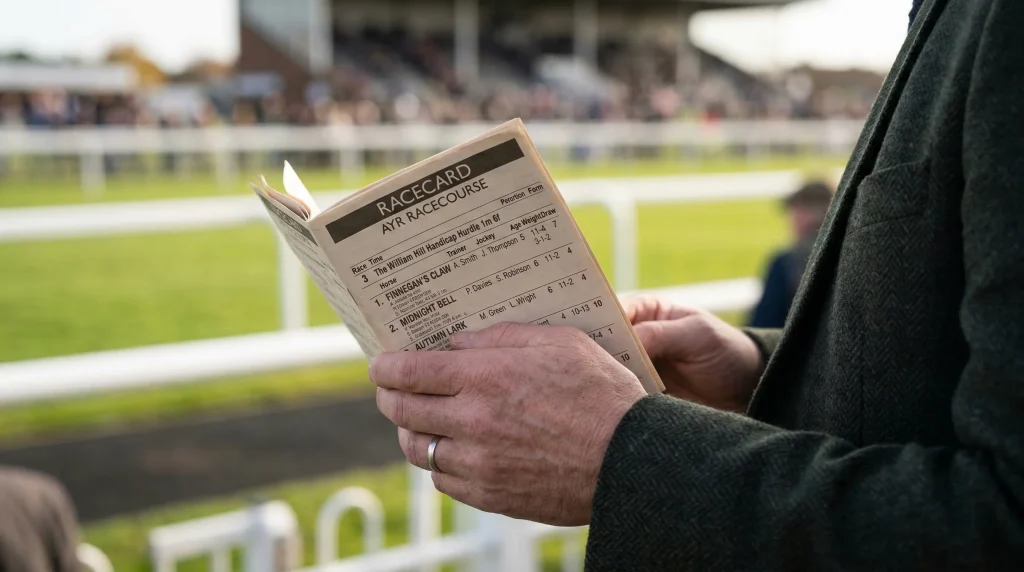
Decoding the Racecard
The racecard contains everything you need to assess runners at Ayr, but only if you understand every symbol on the card. What appears as cryptic shorthand to newcomers reveals detailed racing histories to those who can interpret it. Learning to decode racecards transforms betting from guesswork into informed decision-making, providing the foundation for serious race analysis.
As Alan Delmonte, Chief Executive of the Horserace Betting Levy Board, observed, racing needs to be presented in ways attractive to modern consumers. Racecards represent racing’s traditional information format, evolved over decades to compress maximum data into minimal space. While digital platforms now offer expanded information, the racecard remains the standard reference that punters across Britain use to compare runners.
This guide explains the form figures, symbols and codes that populate Ayr racecards, demonstrating how to extract meaningful information from compressed notation. Mastering racecard interpretation enables faster analysis at the track and provides skills applicable across all British racecourses, not just Ayr.
The mark beside each horse is explained in handicap ratings.
Form Figures: What the Numbers Mean
Form figures appear beside each horse’s name, showing finishing positions in recent races. A sequence like 1324 indicates the horse finished first, third, second, then fourth in its last four runs, reading left to right from oldest to most recent. These figures provide immediate insight into recent performance without requiring detailed race-by-race examination.
Numbers 1 through 9 represent finishing positions directly. A horse showing 111 has won its last three races, while 999 has finished ninth in each recent outing. Zeros indicate finishing positions of tenth or worse, compressing poor performances into single characters. The sequence 0-0 shows two runs finishing outside the first nine, with the dash separating different seasons.
Letters carry specific meanings within form strings. F indicates a fall, U an unseating of the rider, P a pulled-up, R a refusal, and B a brought down by another horse. These letters appear in National Hunt form where jumping incidents affect outcomes. A horse showing 2F1 finished second, fell, then won, reading oldest to most recent. Such sequences reveal jumping reliability or lack thereof.
Dashes separate seasons within form strings. A horse showing 21-34 finished second then first last season, third then fourth this season. This seasonal division helps identify horses returning from breaks or those whose current form differs from previous campaigns. Analysis of recent Gold Cup winners found that 9 of 12 were aged between four and six years, and form figures help identify horses in this productive age range.
Course and distance indicators enhance form figures. A C beside a position shows that result occurred at today’s course; a D indicates the same distance. CD together means the horse achieved that finishing position at this course over this distance, highly relevant information for track-specific analysis. Horses with CD form at Ayr bring proven suitability that first-time visitors lack.
Symbols and Codes: Headgear, Cheekpieces, Blinkers
Equipment symbols indicate what horses will wear during races. Blinkers (b) restrict peripheral vision, focusing the horse’s attention forward. Cheekpieces (p) provide partial restriction, a milder version of blinkers. Visors (v) offer similar restriction with eye holes. First-time application of any equipment often signals trainer intent to produce improved performance.
Tongue ties (t) prevent horses from swallowing their tongues during exertion, addressing a specific physical issue. Hoods (h) calm nervous horses before races, typically removed at the start. Each piece of equipment addresses particular behavioural or physical characteristics, and understanding these purposes helps interpret why trainers make changes.
Numbers beside equipment symbols indicate how many times horses have worn them. A horse showing b3 wears blinkers for the third time; b1 indicates first-time blinkers. The first application often produces the most dramatic effect, whether positive or negative, as horses respond to novel sensory input. Experienced punters track equipment changes closely for this reason.
Going preferences appear as abbreviations throughout racecards. Firm (F), good to firm (GF), good (G), good to soft (GS), soft (S), and heavy (H) describe ground conditions. A horse with winning form on soft ground marked S may struggle when conditions ride faster. Matching horses’ proven going preferences to actual conditions improves selection accuracy significantly.
Trainer and jockey codes identify connections. While names appear in full elsewhere, some racecard formats use abbreviated codes that require familiarity to interpret. Recognising which trainers and jockeys excel at Ayr, as discussed in earlier guides, adds context that raw form figures cannot provide. The combination of form, equipment and connections creates complete pictures of each runner’s prospects.
The wider context is set out in our Ayr betting guide.
Applying Knowledge: From Card to Bet
Converting racecard interpretation into betting decisions requires systematic analysis. Start by eliminating horses whose form figures show consistent poor performance, those with strings of high numbers or symbols indicating jumping failures. This initial filter reduces large fields to manageable shortlists that warrant deeper examination.
Course and distance form deserves particular weight at Ayr. Horses showing CD indicators have proven they handle this specific track over this specific trip. While previous success does not guarantee future victory, it demonstrates capability that unproven horses must establish. Prioritising proven performers over speculative entries improves strike rates over time.
Recent form matters more than historical form. A horse that won three times two seasons ago but has shown nothing since carries less relevance than one with modest but improving current performances. Focusing on the most recent figures in form strings, those furthest right, captures current ability rather than faded history.
Equipment changes signal trainer intent. First-time blinkers or cheekpieces suggest connections believe something has been preventing the horse from performing to ability. Whether that belief proves correct varies, but the change itself indicates active management rather than hopeful entry. Tracking which trainers achieve success with equipment changes identifies patterns worth following.
Market movements add real-time intelligence to static racecard information. Horses whose prices shorten significantly suggest informed support from connections or observers who know more than public form reveals. Conversely, drifting prices may indicate issues that racecard analysis cannot detect. Combining racecard fundamentals with market dynamics produces more complete assessments than either alone. Statistics show that only 4 of the past 24 Gold Cup favourites won, demonstrating that market support alone does not guarantee success.
Draw information supplements traditional racecard data at Ayr. While not always prominently displayed, stall positions critically affect sprint races on the straight course. Cross-referencing drawn positions with course-specific draw bias analysis adds dimensions that standard racecard interpretation misses. A horse with excellent form but a poor draw may offer less value than its figures suggest.
Building racecard fluency requires practice. Reading cards before every race, comparing interpretations to actual results, and refining understanding over time develops expertise that quick study cannot match. The investment pays dividends not just at Ayr but across all British racing, as racecard conventions remain consistent nationwide despite minor formatting variations between publications.
Racecard Skills and Realistic Expectations
Racecard literacy improves betting decisions but cannot guarantee profits. Even well-analysed selections lose regularly, and no amount of study eliminates uncertainty. Use racecard skills as one tool among many, stake within your limits, and treat betting as entertainment. If gambling creates pressure, support is available through GamCare and the National Gambling Helpline.
