
Ayr 7f and 1m Races: Where Draw Bias Disappears
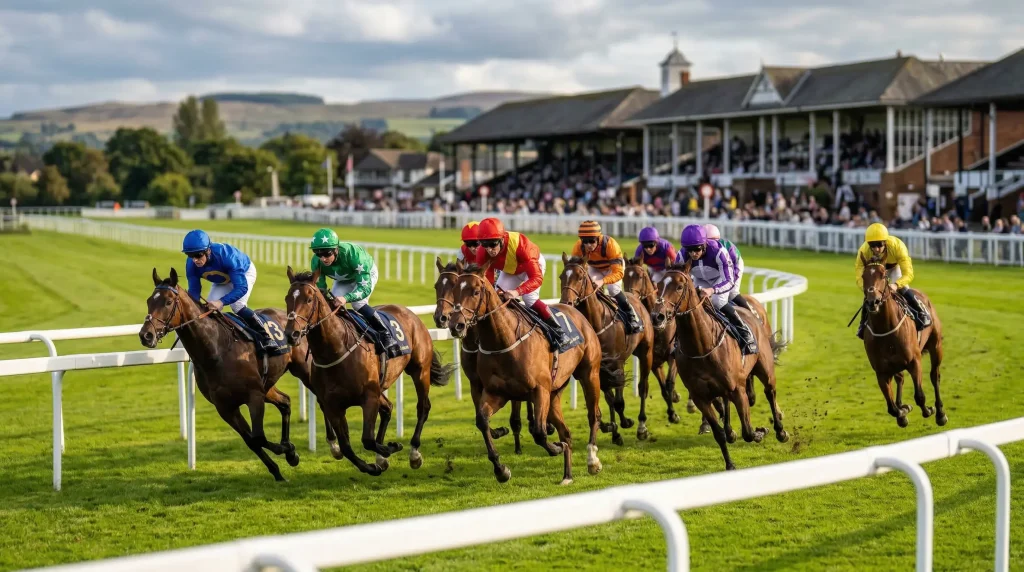
Where Draw Advantage Fades
Punters who apply sprint-race thinking to seven furlongs and one mile at Ayr make costly analytical errors. These are the distances where form matters more than stall position, where the bends and additional yardage neutralise the draw biases that dominate shorter trips. Understanding why draw becomes irrelevant at these distances prevents misallocation of analytical effort and redirects attention toward factors that actually influence outcomes.
The seven-furlong and one-mile courses at Ayr incorporate turns that the straight sprint track lacks. These bends give jockeys time and space to manoeuvre regardless of starting position, allowing talented horses to overcome positional disadvantages that would prove insurmountable over five or six furlongs. The geometry that creates draw bias at sprint distances simply does not apply once races include meaningful curves.
This guide examines the statistical evidence demonstrating draw neutrality at seven furlongs and one mile, explains the mechanical reasons behind this neutrality, and identifies the factors that punters should prioritise instead of stall position. Recognising where draw analysis adds value and where it wastes time improves betting efficiency across Ayr’s varied programme.
7f Analysis: Equal Distribution Data
Statistical analysis of seven-furlong handicaps at Ayr reveals no meaningful draw bias. Examination of 170 handicaps run between 2009 and 2020 found winners distributed evenly across stall positions, with no cluster toward low or high numbers that would indicate systematic advantage. The data confirms what course geometry suggests: the turn into the straight provides sufficient distance for positional adjustments that eliminate starting-stall effects.
The seven-furlong start at Ayr positions horses on a chute that feeds into the round course. Runners travel approximately three furlongs before negotiating the turn into the home straight, giving jockeys multiple opportunities to find positions that suit their mounts. A horse breaking slowly from a wide draw can drift toward the rail through the turn; a horse drawn low can ease wide to find running room if the rail becomes congested. These options do not exist at sprint distances where the entire race unfolds on the straight.
Pace scenarios matter more at seven furlongs than stall position. Races over this trip often feature tactical battles where early speed is not automatically rewarded. Horses that settle behind the pace through the first half can accelerate through the turn and deliver a finishing effort that catches front-runners who have burned energy establishing position. Identifying likely pace scenarios, based on the running styles of declared runners, provides more predictive value than draw analysis.
Going conditions affect seven-furlong races without reintroducing draw bias. Soft ground slows the pace overall and rewards horses with stamina reserves; fast ground enables front-runners to maintain speed through the turn. These effects operate uniformly across the field regardless of starting position, changing race dynamics without favouring particular stalls. Punters should factor going into their assessments but should not expect it to create draw-dependent patterns.
1 Mile Analysis: Draw Irrelevance
One-mile races at Ayr show even less draw influence than seven-furlong contests. Analysis confirms no statistically significant relationship between stall position and finishing position over this distance. The additional yardage and the course configuration combine to render starting position essentially random with respect to outcome, allowing punters to disregard draw entirely when assessing mile races.
The one-mile start positions horses further around the course, requiring them to negotiate approximately half the oval before entering the home straight. This distance provides abundant time for the field to sort itself into running order based on ability and jockey tactics rather than starting position. By the time runners reach the final turn, their original stalls have no bearing on their current positions.
Mile races at Ayr tend to reward horses with tactical speed and finishing acceleration. The distance is long enough to punish pure front-runners who cannot sustain their effort, yet short enough to disadvantage one-paced stayers who lack the gear change to accelerate in the final furlong. Identifying horses whose running styles match these demands provides analytical edge that draw-focused approaches cannot supply.
Class and form become the dominant factors at one mile. Without draw bias to distort outcomes, the better horses win more reliably than they do in sprint handicaps where stall position can override ability. This reliability means that form analysis at one mile produces more consistent results, rewarding punters who invest time in understanding each runner’s recent performances and likely trajectory.
Betting Adjustments: What to Focus on Instead
With draw removed from consideration, punters analysing seven-furlong and one-mile races at Ayr can redirect attention toward factors that genuinely influence outcomes. Form analysis takes primacy: recent performances, course and distance suitability, and trainer intentions all carry greater weight when positional lottery is eliminated. This shift in focus typically improves analytical efficiency because form factors are more predictable than draw effects.
Trainer and jockey combinations warrant close attention at these distances. Certain partnerships excel at Ayr regardless of the draw their horses receive, suggesting that course knowledge and tactical awareness override starting position. Tracking which combinations consistently outperform market expectations over seven furlongs and one mile identifies patterns that inform future betting decisions.
Pace analysis becomes more valuable when draw bias disappears. Mapping the likely positions of each runner through the early stages of the race, based on their established running styles, helps predict which horses will find trouble in running and which will enjoy uncontested trips. A horse that races prominently and handles turns efficiently may not be the best on ratings but could outperform its odds through tactical positioning that draw cannot provide.
Going preferences deserve more weight at middle distances than at sprints. Horses running seven furlongs or one mile spend more time on the surface, amplifying the effects of ground conditions on their performance. A soft-ground specialist who struggles on fast surfaces will underperform regardless of form, while a horse with a strong good-to-firm record gains advantage when conditions suit. Matching ground preferences to actual going produces consistent edge over punters who ignore this factor.
Trip suitability also requires attention. Some horses are suited by the sharp seven furlongs but lack stamina for a true mile; others need every yard of the longer distance to deliver their best. Assessing whether each runner is ideally suited to the precise distance, rather than treating seven furlongs and one mile as interchangeable, identifies mismatches between horse and race that create betting opportunities.
The absence of draw bias also affects each-way calculations. In sprint handicaps, draw can create artificial placing chances for horses drawn favourably even if they lack winning quality. At seven furlongs and one mile, placing probability correlates more directly with ability, making each-way bets on moderate horses less attractive. The place portion of each-way wagers delivers returns when horses outperform their win probability, and without draw effects to create such outperformance, the mathematics favour win-only betting on preferred selections.
Smart Analysis, Uncertain Outcomes
Improved analytical focus does not guarantee betting profits. Even well-reasoned selections lose regularly, and no amount of form study can eliminate uncertainty. Bet within your limits and treat stakes as entertainment expenditure. If gambling creates stress rather than enjoyment, support is available through GamCare and the National Gambling Helpline.