
Ayr Racecourse Track Guide: Layout, Distances and Going Conditions
Scotland’s Premier Racing Venue
Ayr Racecourse occupies a singular position in British racing. It is Scotland’s only Grade 1 dual-purpose track, staging both Flat and National Hunt fixtures across 155 acres on the South Ayrshire coast. The venue holds approximately 18,000 spectators and hosts around 32 racing days each year, making it the busiest course north of the border. For punters seeking to understand how the track behaves before committing their stakes, this guide breaks down the layout, distances and ground characteristics that define racing at Ayr.
The course sits less than two miles from Ayr town centre, nestled between the coast and rolling farmland. Its location shapes everything from the going to the wind conditions that can alter sprint outcomes. Unlike many inland tracks, Ayr’s sandy subsoil provides natural drainage that keeps abandonment rates low even during Scotland’s wetter months. This reliability draws quality fields throughout the season, from the Western Meeting in September to the Scottish Grand National Festival in April.
Understanding the physical characteristics of any track gives bettors an edge that form alone cannot provide. A horse with brilliant York form may struggle with Ayr’s undulations; a proven stayer at Cheltenham might find the National Hunt course’s demands subtly different. The following sections examine the Flat and jumps configurations, the distances that favour certain running styles, and the ground conditions that shape each meeting. Scotland’s only Grade 1 dual-purpose track rewards those who take the time to study its contours.
The Flat Course: Left-Handed Oval and Sprint Track
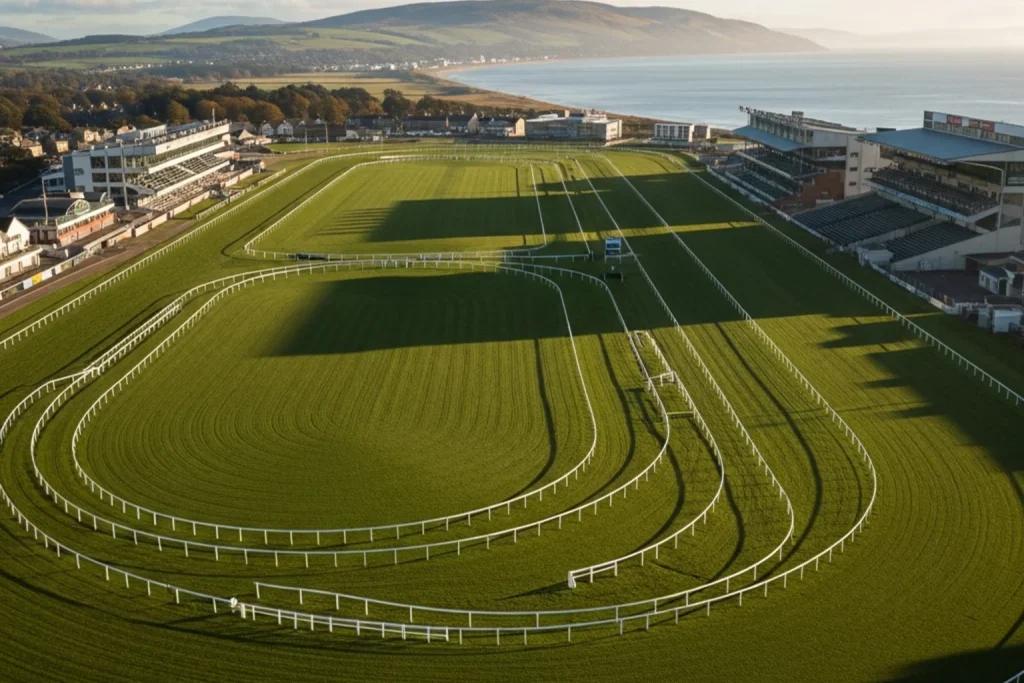
The Flat course at Ayr runs left-handed around an oval of roughly one mile six furlongs in circumference. The home straight measures approximately three and a half furlongs, featuring a gentle climb to the winning post that tests finishing speed after the final turn. Races over seven furlongs and a mile start from chutes that feed into the main loop, while the sprint distances use a separate straight track that joins the round course near the two-furlong pole.
The six-furlong straight course is where Ayr builds its reputation as a sprinting venue. This track runs down the stands side, and its configuration creates distinct draw biases depending on the going. On good to firm ground, runners drawn high can take the stands rail and benefit from the faster strip. When the ground turns soft, the advantage typically swings toward lower draws, where fresher ground lies. Ayr is one of only three British courses that regularly repositions starting stalls across the track, using three distinct stall configurations to distribute wear evenly. This system matters for bettors because the clerk of the course announces stall positioning before raceday, and that announcement carries genuine market implications.
The five-furlong sprint course presents its own geometry. It shares the stands-side rail with the six-furlong track but places even greater emphasis on early pace and positioning. Runners breaking sharply from high draws often establish an unassailable lead before the field can regroup. The track’s cambered nature amplifies this effect, tilting slightly toward the stands rail in a way that gives rail-runners a gravitational assist. Data from recent seasons shows that two-thirds of five-furlong winners at Ayr crossed the line toward the stands side, regardless of where they began.
Races beyond six furlongs behave differently. The seven-furlong and one-mile trips include bends, and those bends neutralise the draw bias that defines pure sprints. Analysis of 170 handicaps at seven furlongs between 2009 and 2020 found no statistically significant draw advantage. The same pattern holds for mile races, where the longer distance and additional turns give jockeys time to overcome positional disadvantages. For betting purposes, this means punters should weight draw analysis heavily at sprint trips and virtually ignore it beyond six furlongs.
The National Hunt Circuit: Jumps Course Configuration
The National Hunt course at Ayr shares the left-handed orientation of its Flat counterpart but presents a distinctly different challenge. The jumps circuit is tighter, with sharper bends that test a horse’s balance and a demanding fence layout that punishes the careless. Hurdle races feature flights positioned to examine a runner’s jumping rhythm, while the chase course incorporates plain fences and an open ditch that has unseated many a favourite over the years.
The Scottish Grand National course extends beyond the standard circuit. At three miles seven furlongs and 176 yards, it ranks among the longest races in Britain, and the extra distance places extreme demands on stamina. Runners face 27 fences across the marathon trip, including several that arrive when legs are tiring and concentration lapses. The ground typically rides softer than the Flat course during the April festival, adding to the energy expenditure. Horses that lack genuine staying power tend to empty before the home straight, no matter how well they jumped earlier in the race.
The undulations around the back straight test jumping technique under subtle gradients. While Ayr lacks the severe hills of Cheltenham or Towcester, its contours remain significant enough to disadvantage runners who jump left or fail to maintain rhythm through transitional ground. The final run-in from the last fence measures approximately two furlongs, offering enough distance for a rallying stayer to overhaul a tired leader but not so much that flat speed alone decides the outcome. The configuration rewards well-balanced horses that handle softer ground without losing their stride.
For jumps bettors, the key considerations at Ayr involve stamina, ground preference and jumping accuracy. Form from flatter tracks like Musselburgh or Kelso does not translate directly because the Ayr circuit presents different questions. Horses with strong records at undulating venues like Wetherby or Haydock tend to adapt better. The drainage remains reliable even through winter rainfall, but genuine soft or heavy going is more common on the jumps course than the Flat track during peak National Hunt months.
Going Conditions: What to Expect from the Ground
Ayr’s sandy subsoil provides drainage that rivals any coastal course in Britain. The track sits on a base that allows rainwater to filter through efficiently, preventing the waterlogging that forces abandonment at clay-based venues. This geological advantage keeps the going closer to good than heavy throughout most of the calendar, even during the wettest Scottish winters. Course officials can water the track during dry spells to maintain safe ground, while natural rainfall dissipates faster than at inland alternatives.
The west coast climate brings its own patterns. Ayr experiences more rain than tracks in eastern Scotland or northern England, but the precipitation arrives in predictable seasonal rhythms. Autumn meetings during the Western Meeting and Gold Cup Festival often enjoy good to firm conditions as summer fades, while the spring Scottish Grand National Festival encounters softer going as the ground recovers from winter. Checking the forecast and comparing it to the track’s historical responses gives punters genuine insight ahead of each fixture.
Going conditions affect different parts of the track differently. The Flat straight course tends to ride slightly faster than the round course because it receives more maintenance attention during the sprint-heavy months. The National Hunt circuit, which shoulders most winter racing, develops inconsistencies that favour runners comfortable on variable ground. The chase track in particular shows patches of firmer and softer going depending on where horses land and take off. Official going descriptions provide a starting point, but attending punters who walk the course notice variations that the headline description obscures.
For betting purposes, monitoring the going report matters most for sprint races on the Flat course and for the Scottish Grand National during the jumps season. Both situations present conditions where ground preference can override raw ability. A sprinter bred for firm ground may struggle when unexpected rain arrives overnight; a staying chaser that relishes heavy going gains lengths per mile when the forecast delivers. Tracking official updates through the Ayr Racecourse website and cross-referencing with independent weather data produces the clearest picture of what the ground will offer on race day.
Betting Within Your Limits
Betting on horse racing should remain an enjoyable part of the sport, not a source of financial or emotional strain. Set deposit limits before each meeting and treat your stake as entertainment expenditure rather than investment capital. If you find yourself chasing losses or spending beyond your means, support services such as GamCare and the National Gambling Helpline offer confidential assistance. The thrill of backing winners at Ayr is best experienced within boundaries you can sustain.