
Scottish Grand National History: Past Winners and Racing Stories
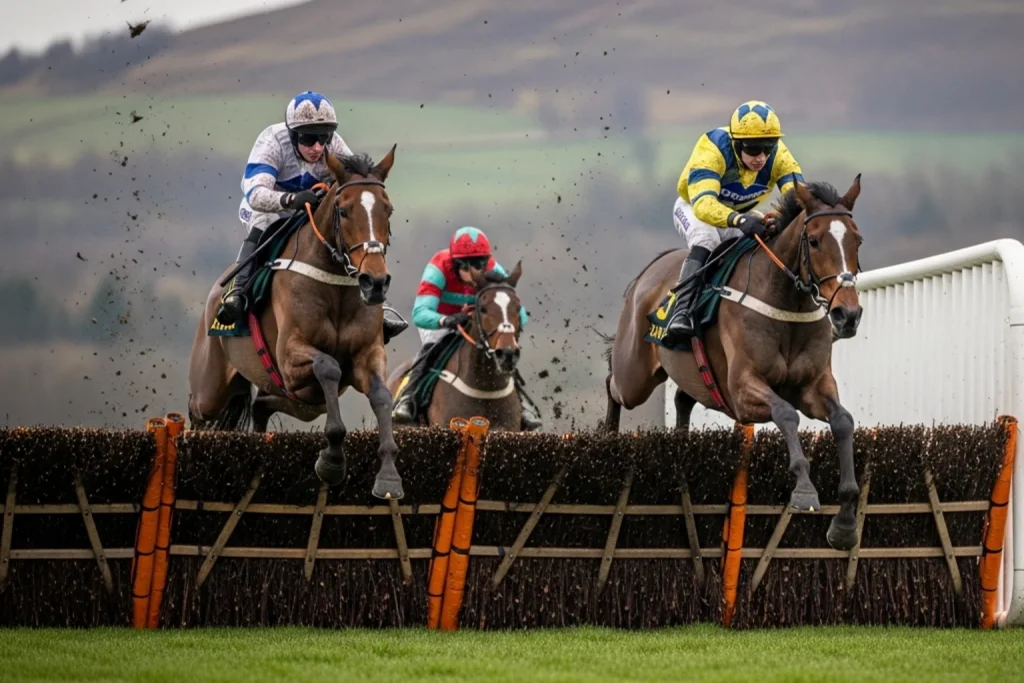
Scotland’s Marathon Legacy
The Scottish Grand National stands as Scotland’s ultimate test of stamina, a marathon steeplechase that demands everything from horse and jockey alike. Run over three miles seven furlongs at Ayr each April, the race offers £200,000 in prize money and ranks among the top five most-bet races in British racing. Its heritage stretches back to the late nineteenth century, predating its permanent home at Ayr and surviving multiple relocations before settling into its current position on the jumps calendar.
Unlike its Aintree counterpart, the Scottish Grand National places greater emphasis on stamina than spectacle. The fences are testing but not freakish; the distance is punishing rather than dangerous. Horses that complete the course have proven their durability over 27 obstacles across terrain that tires even the hardiest stayers. The race tends to reward genuine staying power over raw speed, and its finishing order often differs dramatically from what pre-race analysis suggests.
The history of the Scottish Grand National reflects broader shifts in British racing, from the sport’s Edwardian heyday through wartime disruptions to modern commercial pressures. Through every era, the race has maintained its identity as a genuine test of thoroughbred endurance. Understanding that history helps modern punters appreciate what type of horse succeeds at Ayr in April and why certain form lines prove more predictive than others. This is Scotland’s marathon legacy, and it rewards those who study its past.
Early Years: The Bogside Era
The Scottish Grand National began life at Bogside Racecourse in Irvine, roughly 12 miles north of its current Ayr home. The first official running took place in 1858, though informal marathon races had been staged in the region for years prior. Bogside offered challenging terrain that suited the endurance test organisers envisioned, and the race quickly established itself as a significant fixture on the Scottish calendar.
Racing at Bogside had its limitations. The course lacked the infrastructure to support large crowds, and access proved difficult for spectators travelling from Glasgow or Edinburgh. Prize money remained modest compared to equivalent English events, limiting the quality of fields. Yet the race persisted, building a reputation for gruelling conditions and dramatic finishes that attracted devoted followers. The marathon distance separated genuine stayers from pretenders, creating stories that passed through generations of Scottish racing families.
The early Scottish Grand Nationals featured predominantly local and Irish runners. English-trained horses rarely made the journey north for a prize that paled beside their home options. This insularity gave the race a distinctive character, a test designed by Scottish horsemen for conditions they understood. The fences demanded precise jumping technique, while the ground often rode soft through the Ayrshire spring. Horses that won at Bogside proved their toughness beyond doubt.
Bogside served as the Scottish Grand National’s home until 1966, when the course closed and the race faced an uncertain future. The closure reflected broader pressures on smaller British racecourses, which struggled to compete with larger venues for spectators and investment. The Scottish Grand National’s survival depended on finding a new home capable of staging a race of its prestige and physical demands. Fortunately, Ayr Racecourse stood ready to receive it.
Move to Ayr: A New Chapter
The Scottish Grand National arrived at Ayr Racecourse in 1966 and never left. The move brought immediate improvements: better facilities for spectators, easier transport links and a course configuration that suited the marathon distance. Ayr’s National Hunt circuit provided testing fences without the drainage problems that had plagued Bogside during wet springs. The race found a permanent home that could support its growing ambitions.
Prize money increased steadily after the relocation. The current purse of £200,000, with approximately £112,540 going to the winner, reflects decades of investment by Ayr Racecourse and its commercial partners. That financial growth attracted stronger fields from across Britain and Ireland, transforming the Scottish Grand National from a regional curiosity into a fixture that major National Hunt yards target specifically. Irish trainers, recognising that their staying chasers excelled over the distance and ground, began sending runners in increasing numbers.
The April timing positions the Scottish Grand National as the season’s final major staying chase, arriving two weeks after Aintree. Some runners arrive fresh; others attempt the gruelling Aintree-Ayr double that only the hardiest horses can manage. The timing creates unique form puzzles for punters, who must judge how much the Aintree effort has taken out of those that ran and whether the Scottish ground will suit horses that flourished at other spring venues. As Delly Innes of Scottish Racing noted when discussing the industry’s economic potential: “By working closely with other local cultural and tourism assets, Scotland’s racecourses can potentially raise the economic impact of Scottish horseracing to nearly £540m” with projected employment reaching 3,900 jobs through strategic development.
The Ayr era has seen the Scottish Grand National cement its status as the premier staying chase north of the border. Fields now feature runners from leading yards in Ireland, England and Scotland, competing for prize money that justifies the travel and the effort. The race remains what it always was, a genuine test of stamina, but it now commands the resources and attention befitting that challenge.
Memorable Finishes: Races That Defined the National
The Scottish Grand National has produced finishes that linger in the memory long after the crowds disperse. The marathon distance creates scenarios where fortunes reverse dramatically in the final furlongs, where horses that appeared beaten summon reserves their rivals lack. Some renewals have been decided by short heads after four miles of effort; others have seen dramatic late collapses that handed victory to unlikely challengers.
Recent editions underscore Irish dominance in the race. Eight of the fifteen winners between 2011 and 2026 came from Irish yards, a success rate that reflects superior preparation for staying tests on soft spring ground. Willie Mullins landed back-to-back victories in 2026 and 2026, demonstrating that the most powerful yard in jumps racing views the Scottish Grand National as a viable target despite the journey. The Mullins winners arrived at Ayr in peak condition, well suited to the ground and distance demands that others underestimated.
The race tests completion rates as severely as it tests winning credentials. The 2026 edition saw only 8 of 23 starters complete the course, a finishing ratio that illustrates the marathon’s attrition. Horses fall, unseat riders, or simply empty before the final fence. Those that complete demonstrate genuine staying power, and their future form over similar distances tends to hold up better than horses that win shorter events. For punters, previous Scottish Grand National completions represent valuable form when assessing future staying chases.
What makes these finishes memorable is the combination of distance, fatigue and the stakes involved. A short-head victory after nearly four miles carries emotional weight that no sprint can match. The horses that win earn their places in the race’s history through sheer persistence, outlasting rivals across terrain that exposes every weakness. Scotland’s ultimate test of stamina leaves no room for doubt about which horse truly deserved victory on the day.
Marathon Racing Realities
The Scottish Grand National attracts substantial betting interest, but its marathon distance and large fields create inherent unpredictability. Stake only what you can comfortably lose and resist the temptation to recover losses through increased bets. If gambling stops being enjoyable, organisations like GamCare offer free, confidential support. The best finishes are those you can appreciate without financial anxiety.