
Ayr Betting Strategy: Value, Each-Way and Bankroll Tips for Smarter Race-Day Decisions
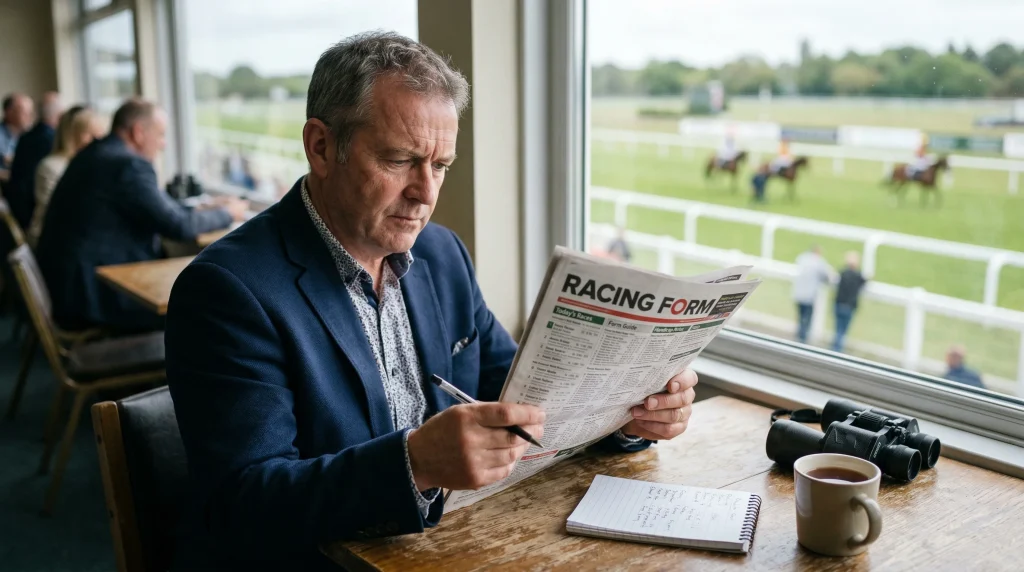
Strategy Over Luck at Ayr
Most bettors approach Ayr racing with methods better suited to smaller fields and simpler contests. They back favourites in 25-runner handicaps, ignore draw bias, and stake without reference to bankroll principles that would protect their capital. These approaches produce predictable losses over time, not because the bettors lack racing knowledge, but because their strategy does not match the specific demands of Ayr’s competitive environment.
Profitable betting at Ayr requires strategy before speculation. The track’s flagship races—the Ayr Gold Cup and Scottish Grand National—feature maximum fields, pronounced biases, and market inefficiencies that reward systematic approaches while punishing intuition-based betting. Smaller races throughout the Ayr calendar present different challenges but still benefit from structured thinking about value, stake sizing, and timing.
This guide provides the strategic framework that serious Ayr bettors need. It begins with context about the UK betting market and how Ayr fits within it, then moves through the core elements of profitable approach: identifying value when favourites consistently underperform, understanding each-way mechanics that suit big-field racing, managing bankroll to survive inevitable losing runs, and timing bets to capture the best available prices.
Nothing in this guide guarantees profits. Horse racing involves irreducible uncertainty, and even perfect strategy produces losing bets more often than winners. What sound strategy does is shift the odds gradually in your favour, creating edges that compound over time while protecting against the catastrophic losses that eliminate casual bettors from the game. At Ayr, where big-field handicaps dominate the calendar, that strategic foundation matters more than anywhere else in British racing.
The approach outlined here integrates with the detailed analysis available for specific Ayr races. Draw bias knowledge informs which selections offer value; trainer and jockey patterns shape how you assess runners; understanding of race profiles clarifies which horses match winning criteria. Strategy ties these elements together into a coherent framework for making better decisions across all Ayr betting opportunities.
Market Landscape: UK Betting Context
Understanding the broader UK betting market provides context for Ayr-specific strategy. Horse racing betting in Britain has undergone significant changes in recent years, with turnover declining and regulatory pressures reshaping how bookmakers and bettors interact. These market dynamics affect the opportunities available at Ayr and how punters should approach them.
Total betting turnover on British horse racing reached £8.73 billion in 2023-24, representing a 16.3% decline from £10 billion just three years earlier. This contraction reflects multiple factors: regulatory affordability checks that limit high-stakes betting, competition from other sports and gaming products, and changing demographic patterns in who bets on racing. The decline has been steeper than headline figures suggest when adjusted for inflation, with real-terms losses approaching £3 billion over the period.
Richard Wayman, Director of Racing at the British Horseracing Authority, has been candid about the causes. “I have no doubt that the drop was headed by the impact of affordability checks,” he observed, identifying regulatory intervention as the primary driver of reduced turnover. These checks, which require bookmakers to verify that customers can afford their betting activity, have particularly affected the top tier of bettors who previously contributed disproportionately to industry revenue.
The concentration of betting revenue matters for market analysis. Research indicates that the top one percent of bettors generate approximately 52% of bookmaker revenue from horse racing—roughly 60,000 individuals contributing more than half of all betting income. When these high-volume bettors face restrictions, their absence affects market liquidity and price formation in ways that create opportunities for smaller-stakes punters who understand the dynamics.
Paradoxically, while betting turnover has declined, the levy yield—the contribution from betting to racing prize funds—reached a record £108.9 million in 2026-25. This apparent contradiction reflects changes in how the levy is calculated and collected, but it means that prize money at venues like Ayr has remained stable or grown even as overall betting activity has contracted. The Ayr Gold Cup’s £180,000 purse and the Scottish Grand National’s record £200,000 fund demonstrate this resilience.
For bettors, the market context suggests several strategic implications. Reduced high-roller activity may create inefficiencies in pricing that attentive punters can exploit. The shift towards smaller-stakes betting aligns with bankroll approaches that emphasise sustainability over aggressive speculation. And the continued investment in prize money ensures that Ayr’s major races attract quality fields worth serious analytical attention.
Value in Handicaps: Why Favourites Fail
The Ayr Gold Cup provides a masterclass in why favourites underperform in big-field handicaps. Between 2000 and 2026, only four market favourites won the race—a strike rate below 17% that would produce losses of roughly four pounds for every pound staked on favourites over the period. This is not random variation; it reflects structural factors that make backing short-priced runners in such contests a systematically losing approach.
Big fields create chaos that undermines predictability. With 25 runners in the Gold Cup and 23 in the Scottish Grand National, even genuinely superior horses face traffic problems, draw disadvantages, and pace scenarios that can prevent them from showing their ability. The favourite might be the best horse on paper, but paper form does not account for being trapped behind a wall of rivals or racing on the unfavoured side of the track.
Handicap weights compound the problem. The British Horseracing Authority assigns weights specifically to compress the field, giving lower-rated horses theoretical chances against more talented rivals. When the system works as designed, every runner has roughly equal probability of winning—which means backing any single horse at short prices offers poor value because you are paying for certainty that does not exist.
The 2026 Ayr Gold Cup attracted 263 entries for 25 places, illustrating the depth of competition that creates these dynamics. Trainers target the race with specifically prepared horses, meaning the field quality is higher than typical Class 2 handicaps. This quality compression means that even modest-rated runners may possess ability closer to fancied horses than their odds suggest.
Value in Ayr handicaps lies not with favourites but with horses who match winning profiles while trading at prices that underestimate their chances. In the Gold Cup, this means targeting runners with favourable draws, appropriate age and weight profiles, and trainer patterns that suggest genuine targeting rather than speculative entry. In the Scottish Grand National, value concentrates on proven stayers with clean jumping records whose stamina credentials the market has not fully appreciated.
Opposing favourites requires discipline. The instinct to back the market leader feels safer, and the occasional favourite victory reinforces this bias. But over time, the mathematics favour punters who systematically identify overlays in the middle and outer reaches of the market while avoiding the trap of paying short prices for uncertain outcomes. This approach produces lower strike rates but higher long-term returns.
The search for value should be active rather than passive. It involves studying the race beforehand, identifying horses who match trend criteria, and then comparing your assessment against market prices to find discrepancies. When a horse you rated as a genuine 10/1 chance trades at 20/1, that represents potential value. When a horse you assessed at 10/1 is favourite at 4/1, the market has priced out the value regardless of the horse’s ability.
Maintaining records of value assessments versus outcomes helps refine your approach over time. When horses you identified as overlays consistently place or win, your value identification process is working. When overlays consistently underperform, something in your assessment methodology needs adjustment. Without data, these patterns remain invisible, and improvement becomes impossible.
Form interpretation requires handicap-specific thinking. A horse who won a conditions race last time does not automatically transfer that form to a handicap where weight differences apply. Previous handicap form, particularly in similar-sized fields at comparable class levels, provides more reliable guidance. Prioritise horses whose recent efforts came in environments matching what they will face at Ayr rather than those with superficially impressive form in different contexts.
The weight of recent form deserves calibration. Horses arriving at Ayr after three consecutive wins have typically been raised significantly by the handicapper, meaning their current mark may exceed their ability. Conversely, horses showing progressive improvement that has not yet triggered major rating adjustments may prove well-handicapped. Identifying runners whose current marks underestimate their trajectory offers more value than backing those whose past wins have already been penalised.
Each-Way Mechanics: Place Terms and Calculations
Each-way betting represents the natural approach for Ayr’s big-field handicaps, but understanding the mechanics is essential for using it profitably. An each-way bet consists of two equal stakes: one for the horse to win, one for it to place. The terms governing each-way bets vary by field size and bookmaker, creating opportunities for informed bettors while trapping those who do not understand the calculations.
For handicaps with 16 or more runners, standard each-way terms pay one-quarter the odds for places, typically to fourth position. Some bookmakers enhance these terms for major races like the Ayr Gold Cup, offering one-fifth the odds or extending places to fifth. These enhanced terms materially affect expected value calculations: a horse at 20/1 with one-fifth places returns four pounds per pound staked for a place finish, versus five pounds at one-quarter terms.
The mathematics of each-way value deserve careful attention. For an each-way bet to offer positive expected value on the place portion alone, the implied probability of placing must exceed the actual probability. A 20/1 shot at one-fifth the odds for places effectively offers 4/1 for a place finish—implying roughly 20% probability. If your analysis suggests the horse has better than a 20% chance of finishing in the first four, the place portion offers value regardless of winning chances.
In the Scottish Grand National, low completion rates dramatically improve place value. When only eight of twenty-three starters finish, horses in fourth place have beaten roughly two-thirds of the field. Yet place odds remain calculated on the assumption that most runners complete. This structural inefficiency creates each-way value on proven stayers whose primary skill is staying on their feet for four demanding miles.
Calculating potential returns before betting helps identify worthwhile each-way propositions. For a £10 each-way bet at 20/1 with one-quarter places: a win returns £210 for the win portion plus £55 for the place portion (£265 total from £20 staked); a place finish returns £55 (profit of £35 from £20 staked). Understanding these numbers before betting prevents disappointment when selections place rather than win.
Comparing bookmaker place terms becomes routine practice for serious each-way bettors. One bookmaker might offer four places at one-fifth odds while another offers five places at one-sixth. The second option often provides better expected value because the additional place more than compensates for the reduced fraction. Shopping for terms is as important as shopping for best prices on the win market.
Each-way betting suits middle-priced selections better than favourites or rank outsiders. A 4/1 favourite offers poor each-way value because the place portion pays only evens, while a 100/1 outsider’s place chances are usually too slim to justify the stake. The sweet spot lies roughly between 8/1 and 33/1, where place returns become meaningful while place probability remains realistic.
Place-only betting provides an alternative when you assess place probability highly but winning chances marginally. Some bookmakers offer place-only markets at enhanced terms, particularly for major races. A horse you rate 40% to place but only 5% to win may offer better value in place-only markets than each-way, where the win portion dilutes returns. Accessing these markets requires accounts with multiple bookmakers.
Bookmaker each-way promotions can transform marginal bets into clear value. Extra place offers, enhanced odds specials, and place insurance deals shift the mathematics substantially. Tracking these offers across bookmakers during major meetings represents low-effort value creation that casual punters ignore. The administrative overhead of managing multiple accounts pays dividends when promotions concentrate around flagship races.
Bankroll Approach: Stake Sizing for Big Fields
Bankroll management separates sustainable bettors from those who experience the common pattern of winning runs followed by catastrophic losses. At Ayr, where big-field handicaps produce low strike rates even for well-selected horses, bankroll discipline becomes especially critical. The question is not whether you will experience losing runs—you will—but whether your staking approach allows you to survive them.
The fundamental principle is betting a small, consistent percentage of your total bankroll on each selection. Most professionals recommend stakes between one and three percent, depending on confidence level and risk tolerance. For a £1,000 bankroll, this means individual bets of £10-30, allowing you to absorb significant losing sequences without depleting capital to the point where recovery becomes impractical.
Fixed-stakes approaches suit Ayr’s handicaps better than progressive systems that increase bets after losses. Chasing losses by doubling stakes after losing bets is mathematically destructive and emotionally dangerous. A losing run of eight consecutive bets—entirely possible in big-field handicaps—would require stakes 256 times the original bet under a doubling system, rapidly exceeding most bankrolls and rational stake limits.
Diversification within individual meetings provides additional protection. Rather than concentrating stakes on a single Ayr Gold Cup selection, spreading the same total across three or four horses who match your criteria increases the probability of landing at least one winner or place finish. This approach accepts lower potential maximum returns in exchange for reduced variance—a trade-off that suits bankroll preservation.
Record-keeping supports better bankroll management by revealing patterns in your betting. Tracking every bet—selection, odds, stake, result—allows you to calculate actual strike rates and returns over time. When data shows that a particular approach is not working, you can adjust before losses accumulate beyond recovery. Without records, you are guessing about your performance rather than measuring it.
Separating betting bankroll from other money provides psychological protection. The amount you allocate to racing should represent entertainment spending that you can afford to lose entirely. When betting money feels fungible with rent or savings, the emotional pressure to chase losses or increase stakes becomes intense and usually destructive. Clear boundaries support clearer decision-making.
Accepting the reality of variance prevents overreaction to both winning and losing runs. A profitable long-term approach will produce periods of losses followed by periods of gains. Neither extreme indicates that your underlying strategy is fundamentally flawed or suddenly brilliant. Maintaining consistent staking through variance requires discipline, but it is the only way to allow edge to manifest over sufficient sample sizes.
Timing Tactics: Ante-Post vs On-The-Day
When you place a bet matters almost as much as what you bet on. Prices for major Ayr races fluctuate significantly between ante-post markets opening and final declarations, creating opportunities for bettors who understand timing dynamics. The choice between early and late betting involves trade-offs that depend on your analysis confidence and risk tolerance.
Ante-post markets for the Ayr Gold Cup and Scottish Grand National open weeks or months before the races. Prices at this stage reflect limited information—entries have been made but not all contenders are confirmed, conditions remain unknown, and the draw has not been published. This uncertainty creates potential value because odds may underestimate horses who later receive favourable circumstances or overestimate those who subsequently face disadvantages.
The risks of ante-post betting are significant. Non-runner rules vary between bookmakers: some return stakes, others do not. A horse backed ante-post at 16/1 who is subsequently withdrawn represents a complete loss under no-refund rules, even if the selection was sound at the time. These non-runner risks mean ante-post bets must offer meaningfully better prices than expected race-day odds to justify the additional uncertainty.
Draw publication for the Ayr Gold Cup creates a key timing moment. Once stall positions are known, draw-aware bettors can assess which horses face advantages or disadvantages. Prices often move significantly in the hours after the draw is published, with well-drawn horses shortening and poorly-drawn runners drifting. Betting immediately after the draw captures value before the market fully adjusts, though this window typically lasts hours rather than days.
Final declarations and market moves on race day provide additional timing opportunities. Watching for late money—significant support for specific horses in the hours before post time—can identify runners that connections fancy without public fanfare. Conversely, drifting prices may indicate that insiders know something negative about a horse’s condition or readiness. These signals are not infallible but add information to selections made on form and trends alone.
The optimal timing strategy depends on individual circumstances. Bettors with strong ante-post analysis who understand non-runner risks can capture significant value by betting early. Those who prefer to minimise uncertainty often wait until final declarations confirm runners and going conditions clarify, accepting shorter prices for reduced risk. Many successful Ayr bettors use both approaches, placing ante-post stakes on strong convictions while reserving additional bankroll for race-day opportunities.
Weather monitoring affects timing decisions for both Ayr flagship races. The September Gold Cup and April Scottish Grand National face different seasonal conditions, but both can see going changes in the days before racing. Checking forecasts and adjusting betting timing based on expected conditions allows you to capture value before the market responds to ground changes that affect draw bias or stamina demands.
Developing a personal timing system based on your research process helps systematise decisions. Some bettors prefer placing core bets after the draw but before the final declarations, accepting that some selections may not run while capturing better prices on those that do. Others wait until race morning when all variables are known, accepting shorter prices for reduced uncertainty. The right approach depends on your analytical confidence and tolerance for the specific risks each timing strategy creates.
Strategy Requires Boundaries
The strategies in this guide are designed to improve betting decisions, not to guarantee profits. Horse racing involves fundamental uncertainty that no system can eliminate. Even optimal strategy produces losing bets more often than winners in big-field handicaps, and extended losing runs are normal rather than exceptional. Approach betting as entertainment with costs attached, not as a reliable income source.
Set firm limits before any betting activity: maximum stakes, maximum losses per session, and total bankroll that represents money you can afford to lose entirely. Never chase losses by increasing stakes beyond your predetermined limits, and never borrow money to fund betting activity. These boundaries protect against the escalation that transforms recreational betting into harmful gambling.
If betting causes concern about finances, time spent, or emotional wellbeing, seek support. GamCare, BeGambleAware, and the National Gambling Helpline provide free, confidential assistance for UK residents. All licensed bookmakers offer responsible gambling tools including deposit limits, loss limits, session time-outs, and self-exclusion through the GAMSTOP scheme. Using these tools proactively is a sign of responsible gambling, not a mark of weakness.
The information in this guide should enhance your understanding of Ayr betting dynamics while supporting rather than undermining responsible gambling practice. If you find that strategic frameworks increase the time and money you spend beyond comfortable limits, step back and reassess. No race result matters more than financial stability and personal wellbeing.